
Loading...
Built for the new era of search: Google, ChatGPT, Gemini and beyond.Explore AI visibility
Loading...
Master the art of generating thousands of SEO-optimized pages at scale. 8 chapters covering strategy, data, templates, AI content, and implementation.

Understand what programmatic SEO is and plan a winning strategy
Find and organize the data that powers thousands of pages
Create templates that scale without sacrificing quality
Use AI to create unique, valuable content for every page
Get pages live on WordPress or any CMS
Track results and scale what works
8 comprehensive chapters to take you from beginner to practitioner

Understand the fundamentals of programmatic SEO and why it works.
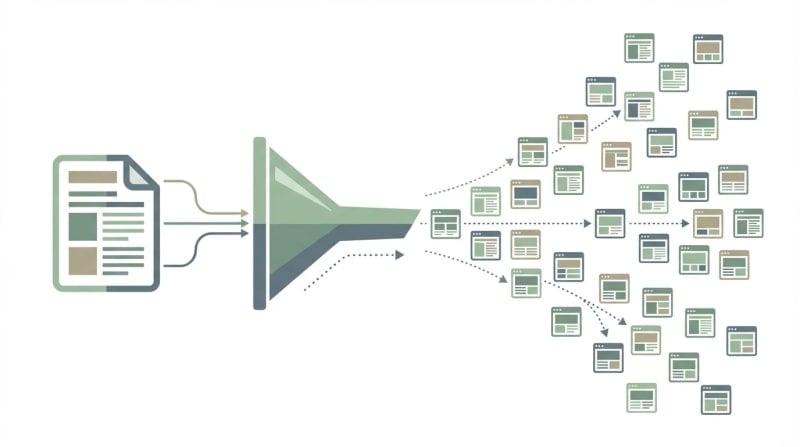
Programmatic SEO is the practice of generating large numbers of web pages automatically using templates, data, and increasingly, AI. Instead of manually crafting each page, you create a template structure and let software populate it with unique content for each variation in your dataset.
Think of it like mail merge for websites. You have a template with placeholders like {{city}}, {{service}}, and {{price}}. You feed in a dataset with thousands of rows - one for each city you serve, each product you sell, or each topic you cover. The system generates a unique page for every row.
Traditional SEO focuses on creating individual, hand-crafted pages targeting specific keywords. A content writer researches, writes, and optimizes one page at a time. This works well for high-value, competitive keywords but doesn't scale.
Programmatic SEO flips this model. Instead of spending hours on one page, you invest upfront in building a robust template and gathering quality data. Then you generate hundreds or thousands of pages at once, targeting long-tail keywords that would be impractical to pursue manually.
The most common programmatic page types include: - **Location pages**: "[Service] in [City]" - targeting local search intent - **Comparison pages**: "[Product A] vs [Product B]" - capturing decision-stage searches - **Data pages**: "[Topic] statistics [Year]" - leveraging unique data - **Glossary pages**: "What is [Term]" - building topical authority
Some of the most successful websites rely heavily on programmatic SEO: - **Zapier**: Over 800,000 integration pages like "Connect Slack to Salesforce" - **Yelp**: Millions of business and location pages - **Tripadvisor**: Destination guides for every city and attraction - **NerdWallet**: Financial product comparisons and calculators - **G2**: Software comparison and review pages
These sites prove that programmatic SEO, when done right, can drive massive organic traffic at scale.

Evaluate if pSEO fits your business model and goals.
Before diving into programmatic SEO, evaluate whether it's the right strategy for your business. Not every website benefits from thousands of pages.
Programmatic SEO works best when you have: - **Repeatable patterns**: Your business serves multiple locations, offers many product variations, or covers numerous topics - **Search demand at scale**: People search for variations of the same query (e.g., "plumber in [city]" across hundreds of cities) - **Data availability**: You can access or create a dataset to power your pages - **Conversion potential**: Each page can realistically convert visitors into customers or leads
Industries that excel with pSEO include: local services, real estate, e-commerce, travel, job boards, directories, and SaaS companies.
To succeed with programmatic SEO, you'll need: - **Data management**: Ability to gather, clean, and maintain datasets - **Template design**: Skills to create page layouts that work at scale - **Content strategy**: Understanding of what makes each page valuable - **Technical implementation**: Capability to publish and manage thousands of pages
Modern tools like InstaRank have reduced the technical barrier significantly. You no longer need developers to build programmatic pages - visual builders and AI content generation make it accessible to marketers.
The main risks include: - **Thin content penalties**: Avoid by ensuring each page provides unique value, not just swapping city names - **Crawl budget issues**: Large page counts can strain indexing; prioritize high-value pages - **Quality degradation**: Template fatigue leads to poor UX; regularly audit and improve - **Competition**: Others can replicate your approach; differentiate with better data or content
Typical timeline: - **Month 1-2**: Strategy, data collection, template development - **Month 3-4**: Initial launch of 100-500 pages, monitoring - **Month 4-6**: Pages begin indexing and ranking - **Month 6+**: Scaling based on results
ROI varies widely but successful implementations often see 200-500% traffic increases within 6-12 months. The key is starting with a focused test, proving the concept, then scaling aggressively.

Create a solid foundation before generating pages.
A solid strategy separates successful programmatic SEO from wasted effort. Before generating a single page, invest time in planning.
Traditional keyword research finds individual keywords. Programmatic keyword research finds patterns. Look for:
2. **Volume validation**: Confirm search demand exists across variations - Check 10-20 sample keywords to estimate aggregate volume - Use tools like Ahrefs or SEMrush to analyze the pattern
3. **Competition assessment**: Evaluate who ranks for sample queries - If major players dominate, look for niche angles - Lower competition variations often convert better
Study competitors who use programmatic SEO: - What page types have they created? - What data sources power their pages? - Where are their gaps? (Missing locations, products, etc.) - What content do their pages include?
Find opportunities by identifying underserved variations. Maybe they cover major cities but miss suburbs. Or they compare popular products but not niche alternatives.
Your URL pattern impacts SEO and user experience:
Good: /plumber-in-austin, /plumber-in-dallas Better: /plumbers/austin, /plumbers/dallas (cleaner hierarchy)
Guidelines: - Keep URLs short and readable - Include the primary keyword naturally - Use hyphens, not underscores - Create logical folder structures for related pages - Plan for future expansion (don't paint yourself into corners)
Define what each page must include to provide value:
Document these requirements in a content brief that your templates will follow.

Find and organize the data that powers your pages.
Your data is the foundation of programmatic SEO. The quality of your pages depends entirely on the quality of your data.
A keyword matrix combines your base keywords with modifiers. Example for a legal services site:
| Service | Location | Modifier |
|---|---|---|
| divorce lawyer | Houston | near me |
| personal injury attorney | Dallas | reviews |
| criminal defense lawyer | Austin | cost |
Each combination becomes a potential page. A matrix of 10 services x 50 cities x 3 modifiers = 1,500 pages.
Raw data is rarely ready for use. Common cleaning tasks: - Remove duplicates - Standardize formats (addresses, phone numbers) - Fill missing values - Validate accuracy (check sample entries) - Normalize text (consistent capitalization, spelling)
Use spreadsheet formulas or scripts to automate cleaning. Invest time here - dirty data creates poor pages.
Data goes stale. Prices change, businesses close, statistics update. Plan for maintenance: - **Static data**: Cities, terms - update annually - **Dynamic data**: Prices, availability - update weekly or daily - **User-generated data**: Reviews, ratings - update in real-time
Set up processes to refresh data regularly. Some tools like InstaRank support live connections to Google Sheets or APIs, keeping pages automatically current.
Create templates that scale without sacrificing quality.
Your template determines the quality of every page you generate. A well-designed template scales to thousands of pages without feeling repetitive or thin.
Every programmatic page should include:
Design your template with three types of zones:
Example for a location page: - Static: Company intro, service list, contact form - Variable: City name, local phone number, service area map - AI-generated: Unique paragraph about serving that city, local tips
Programmatic pages create powerful internal linking opportunities:
Automate internal links based on data relationships. If your data includes "state", automatically link to other cities in that state.
Many programmatic pages receive mobile-majority traffic. Design for small screens: - Single-column layouts that stack cleanly - Touch-friendly buttons and links - Fast-loading content (minimize images, optimize code) - Clear hierarchy with scannable headings - Click-to-call phone numbers for local pages
Test your template on multiple devices before scaling. Issues multiply across thousands of pages.
Choose the right approach for unique, valuable content.
The biggest challenge in programmatic SEO is creating unique, valuable content for each page. Modern AI has transformed what's possible.
AI works best for: - **Descriptive content**: Explaining products, services, or locations - **Comparative content**: Highlighting differences between options - **Summary content**: Synthesizing data into readable paragraphs - **FAQ answers**: Addressing common questions per variation
AI struggles with: - Highly technical or specialized content requiring expertise - Opinion pieces or thought leadership - Content requiring current events or breaking news - Deeply personal or emotional narratives
A hybrid approach often works best: AI generates the base content, humans review and enhance key sections.
Your prompts determine content quality. Effective SEO prompts include:
| Spintax creates variations without AI: | ||||
|---|---|---|---|---|
| {Hello | Hi | Welcome} to our {office | location | branch} in {{city}}. |
This produces: "Hello to our office in Austin" or "Welcome to our branch in Dallas"
Use spintax for: - Introductory phrases - Transitional sentences - Call-to-action variations - Common descriptions
Combine spintax with AI for maximum uniqueness.
Never publish AI content without review:
Create a QA checklist and use it consistently before publishing batches.
Get your pages live and indexable.
Getting thousands of pages live and indexed requires careful technical planning.
For WordPress programmatic SEO:
With thousands of pages, help Google discover and index them:
Page speed matters more at scale:
Monitor Core Web Vitals and address issues before they impact rankings.
Track performance and iterate on your strategy.
Programmatic SEO requires ongoing measurement and optimization. Track the right metrics to understand what's working.
GSC is essential for programmatic SEO monitoring:
Create custom filters for your programmatic URLs (e.g., all pages containing "/cities/") to track as a group.
Not all pages will succeed equally. Identify and address:
Once you validate success with initial pages:
Scale aggressively but monitor quality. Rapid expansion without QA leads to diminishing returns.
Templates and tools to accelerate your implementation
Google Sheets template for organizing your programmatic keywords
Best practices for structuring programmatic URLs
Ensure every page meets quality standards
Tested prompts for generating SEO content
Common questions about this programmatic SEO course
Yes, this guide is completely free. We created it to help businesses understand programmatic SEO and make informed decisions. While we do offer InstaRank as a tool to implement programmatic SEO, the knowledge in this guide is valuable regardless of which tool you use.
No coding skills are required. While traditional programmatic SEO required development resources, modern tools like InstaRank allow anyone to create programmatic pages without writing code. This course covers both technical and no-code approaches.
The full course takes about 2-3 hours to read through. However, we recommend taking it chapter by chapter over a week, applying what you learn between sessions. Implementation will take additional time depending on your project scope.
Programmatic SEO principles apply across industries. We cover examples from local services, e-commerce, SaaS, real estate, travel, and more. The strategies are adaptable - you'll learn the frameworks to apply to your specific use case.
Most programmatic SEO courses cost hundreds of dollars and were created before AI tools existed. This guide is free, current, and covers modern approaches including AI content generation. It's also practical - designed for implementation, not just theory.
We don't offer certificates currently, but you'll gain practical skills you can immediately apply. The real proof of learning is implementing a successful programmatic SEO strategy and seeing results in your organic traffic.
Begin your programmatic SEO journey today. Read at your own pace, implement as you learn.
Research a topic, choose a dataset and test your first template.
Group a keyword list before deciding which topics need their own page.
Browse structured datasets and inspect their fields before building a template.
Load a CSV, preview your pages and export content without signing up.